Best Electric Skateboard for Beginners in 2026 — A Manufacturer's Honest Guide
So you’re thinking about getting your first electric skateboard. Before you spend a single dollar, there’s one question you need to answer honestly: do you actually know if you’ll enjoy this?
Electric skateboarding is an incredible sport. But it’s also easy to get swept up in the excitement, spend $800 on a board, ride it twice, and realize it’s not for you. That’s an expensive mistake.
My advice: start smart. Verify that you genuinely love electric skateboarding before you commit serious money to it. A beginner board in the $300–$500 range gives you everything you need to find out — without the financial pain if it turns out you prefer cycling.
I’ve spent nearly a decade manufacturing electric skateboards at Verreal. I’ve seen every component fail, every design flaw surface, and every common beginner mistake play out in real life. This guide is what I’d tell a friend who’s never ridden before.
The Six Things That Actually Matter for a Beginner Board
Most beginner guides talk about “stability” and “comfort” without telling you anything specific. Here’s what to actually look at.
1. Price — Stay Under $500
For a first board, $300–$500 is the right range. You’ll get a board with real components, real range, and real reliability — without the anxiety of having spent a month’s rent on something you’re still learning.
Almost everything in this price range will be a hub motor board. That’s fine for a beginner. Hub motors are quieter, lower maintenance, and perfectly capable for flat city riding and moderate hills. The trade-offs — less power, limited wheel options — matter more to experienced riders than to someone still learning to balance.
Don’t start at $150. Boards at that price cut corners on the three components that matter most: the motor, the battery, and the ESC. You’ll end up with a board that’s unreliable, underpowered, and potentially unsafe.
2. Motor — Size and Configuration Matter
When looking at hub motor boards, don’t go below 90mm motor diameter. Smaller motors have less torque, worse hill-climbing ability, and lower ground clearance. The physics are simple: a bigger motor has more room for magnets and stator windings, which means more power.
Dual drive over single drive, always. A single-motor board isn’t just weaker — it’s less safe. When you brake on an electric skateboard, the ESC applies regenerative braking through the motor. On a single-drive board, only one wheel brakes. The other wheel spins freely. On a downhill, that’s a real safety issue.
One more thing: make sure the urethane sleeve is replaceable. Hub motor wheels have a thin urethane layer on the outside that wears down over time. If it’s not replaceable, you’ll have to buy an entirely new motor when the sleeve wears out. Motors aren’t cheap. Sleeves are. Check before you buy.
3. Battery — Calculate the Range You Actually Need
Battery specs matter more than most beginner guides acknowledge. Here’s how to read them.
Wh (watt-hours) is the number that counts. This tells you the total energy stored. A rough rule: divide the Wh number by 10 to get a realistic range estimate in kilometers. A 144Wh battery gives you roughly 14km. A 216Wh battery gives you roughly 21km.
Manufacturers often inflate range figures. If a brand claims 30km from a 144Wh battery, be skeptical. The math doesn’t support it at normal riding speeds.
Get more range than you think you need. Two reasons. First, electric skateboarding is genuinely fun — you won’t want to stop when the battery runs out. Second, range directly affects battery longevity. If your board has 14km of range and your daily commute is 14km, you’re doing two full charge cycles per day. Battery cells at this price point typically have 500 charge cycles before degradation becomes noticeable. Do the math on how quickly that adds up.
A few tips to make your battery last:
- Keep it away from water and moisture. Water causes short circuits and corrodes electronics.
- Don’t drain the battery to zero. Most Hobbywing remotes will alert you at 20% — when you hear that alarm, stop riding and charge.
- Don’t charge to 100% every time if you can help it. Keeping the battery between 20–80% significantly extends cell lifespan.
- Don’t accelerate hard or climb hills on a nearly empty battery. This causes voltage sag and stresses the cells. (For more on this, read our guide on Electric Skateboard Battery and Voltage Sag Explained.)
Check what cells are inside. Boards in this price range use Chinese domestic cells, which is fine — Chinese cell technology has improved significantly in recent years. What matters is whether the brand is transparent about the cell brand and capacity. If they just say “high quality lithium cells” without specifics, that’s a red flag.
4. ESC — This Is What Controls Everything
The ESC (Electronic Speed Controller) is the brain of the board. It controls acceleration, braking, top speed, and riding modes. A good ESC makes the difference between a board that feels predictable and one that throws you off unexpectedly.
Hobbywing is the gold standard at this price point. Their ESCs are used in hundreds of thousands of boards worldwide. Acceleration is smooth and linear. Braking is gradual and predictable — the kind of braking that builds confidence rather than anxiety. Hobbywing has a dedicated electric skateboard team that continuously refines their firmware. It shows in the riding experience.
What about Lingyi ESC? Lingyi is primarily used by Meepo, and at this point almost exclusively so. Other manufacturers have largely moved to Hobbywing. Our own history with Lingyi wasn’t smooth in the early days — earlier versions had inconsistent acceleration and higher failure rates. That said, Meepo has been using Lingyi at massive scale for years now, and the product has clearly been refined through that volume. The Meepo V5 is proof that Lingyi-powered boards can deliver a solid riding experience. The reason most other brands don’t use Lingyi today isn’t that the product is bad — it’s that Lingyi’s manufacturing capacity is largely committed to Meepo, and Hobbywing has become the natural choice for everyone else.
5. Speed — Slower Is Fine for Beginners
40 km/h is more than fast enough for a beginner. In fact, most beginners should spend their first weeks riding in the lowest speed mode regardless of what the board is capable of.
What matters more than top speed is how the board accelerates and brakes. A board that surges forward aggressively at low throttle will throw you off. A board with smooth, progressive power delivery lets you build confidence gradually. This comes back to ESC quality.
6. Weight and Warranty — The Practical Stuff
Modern hub motor boards typically weigh 7–8kg. That’s manageable. Go over that and carrying the board up stairs or onto public transport becomes genuinely unpleasant.
For warranty, 6 months is the current industry standard for this price range. Anything less isn’t worth considering. Some brands offer longer warranty at a premium — worth it if you plan to commute daily.
Best Electric Skateboards for Beginners in 2026
Here are the boards I’d actually recommend. I’ve been transparent about the trade-offs on each one, including our own product.
1. WowGo 2S MAX — $359
Best overall beginner board
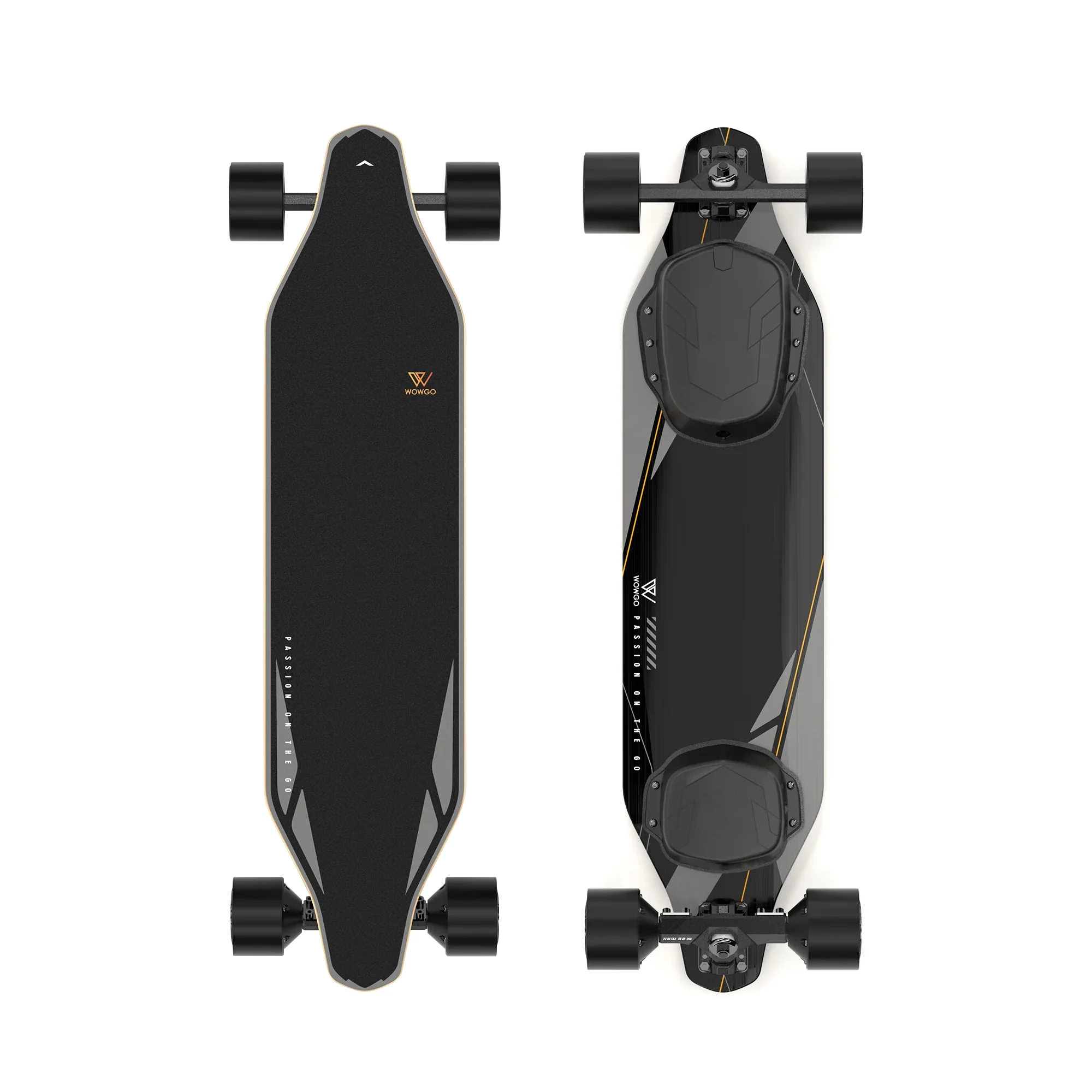 Image credit: WowGo
| Spec | Detail |
|---|---|
| ESC | Hobbywing |
| Battery | 216Wh, 12S2P, 50.4V |
| Range | ~21km (honest estimate) |
| Warranty | 9 months |
| Stock | US, EU, Canada |
The WowGo 2S MAX hits the best combination of specs at this price. The 216Wh battery gives you genuine range, the Hobbywing ESC delivers the smooth riding experience beginners need, and WowGo has been refining this board for years. The 9-month warranty is above the industry standard.
The 12S battery configuration (higher voltage) also means smoother power delivery at lower speeds — a real benefit for beginners still learning throttle control.
Best for: Riders who want the most complete package without overthinking it.
2. Backfire G2 — $349
Most proven beginner board
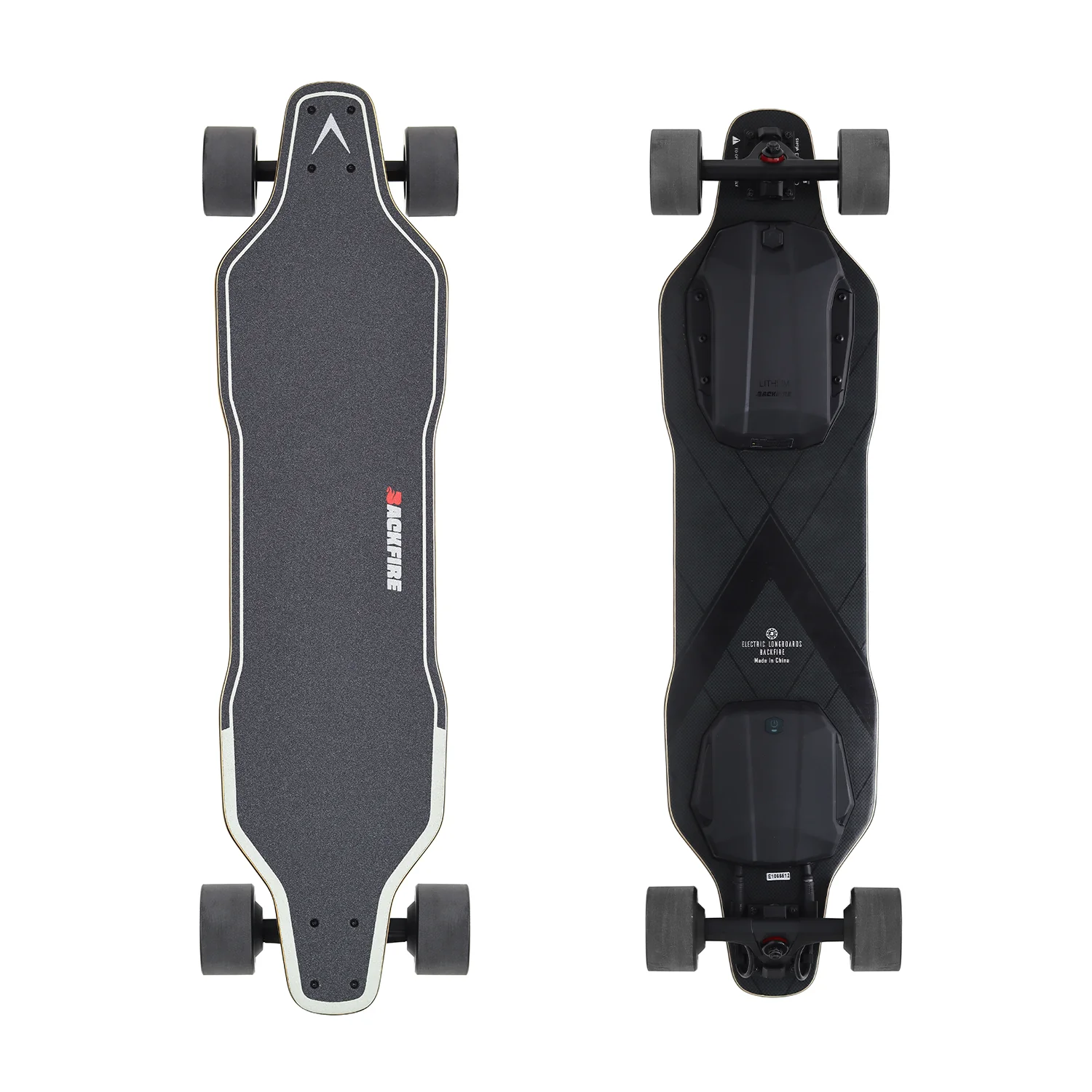 Image credit: Backfire
| Spec | Detail |
|---|---|
| ESC | Hobbywing |
| Battery | 187Wh, 10S2P, Changhong Sunpower cells |
| Range | 18–20km (honest estimate) |
| Warranty | 6 months |
| Stock | US, EU |
The Backfire G2 has been around long enough to have a genuine track record. Backfire is transparent about their cell brand (Changhong Sunpower), which is a good sign. The Hobbywing ESC and years of product iteration make this one of the most reliable options in the category.
Range is slightly lower than the WowGo due to the smaller battery, but still more than enough for most beginners.
Best for: Riders who want a proven, no-surprises board from a brand with a long history.
3. Meepo V5 — $399
Largest community, most support resources
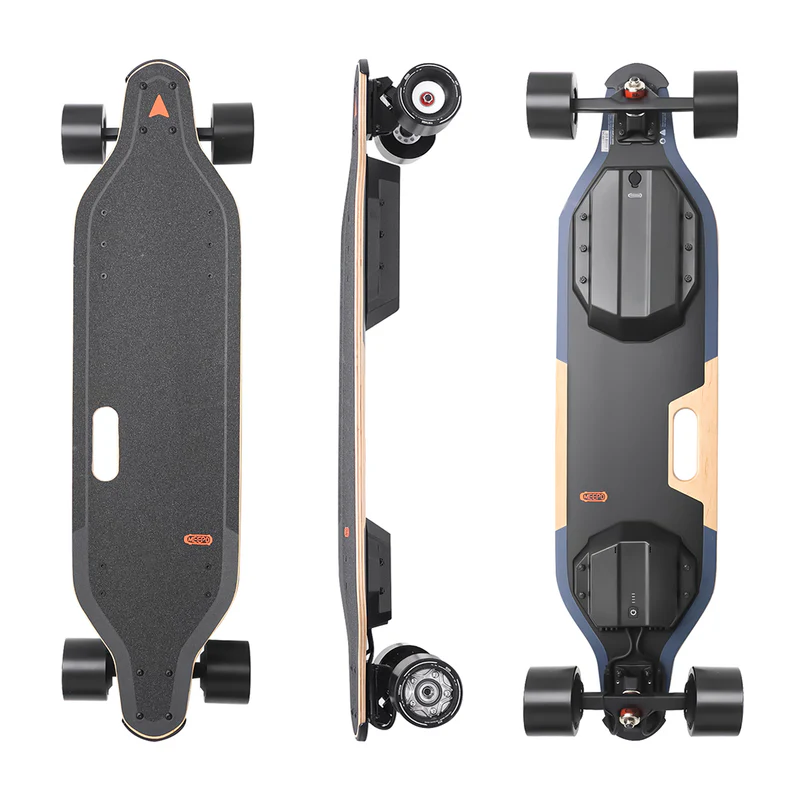 Image credit: Meepo
| Spec | Detail |
|---|---|
| ESC | Lingyi |
| Battery | 144Wh, 10S2P |
| Range | ~15km (real-world estimate) |
| Warranty | 6 months |
| Stock | Fast shipping (5–10 business days) |
Meepo is the most popular beginner electric skateboard brand in the world, and that matters. There’s an enormous community of Meepo riders, more YouTube reviews, more forum threads, and more secondhand parts available than for any other brand at this price.
The Lingyi ESC on the V5 has been refined through years of Meepo-specific tuning and millions of real-world riding hours. It’s a different product from what Lingyi made several years ago.
The main caveat: the 144Wh battery is on the smaller side. The claimed 18km range has some optimism baked in — real-world range for a heavier rider or hillier terrain will be closer to 12–14km.
Best for: Riders who want the biggest community and the most available support resources.
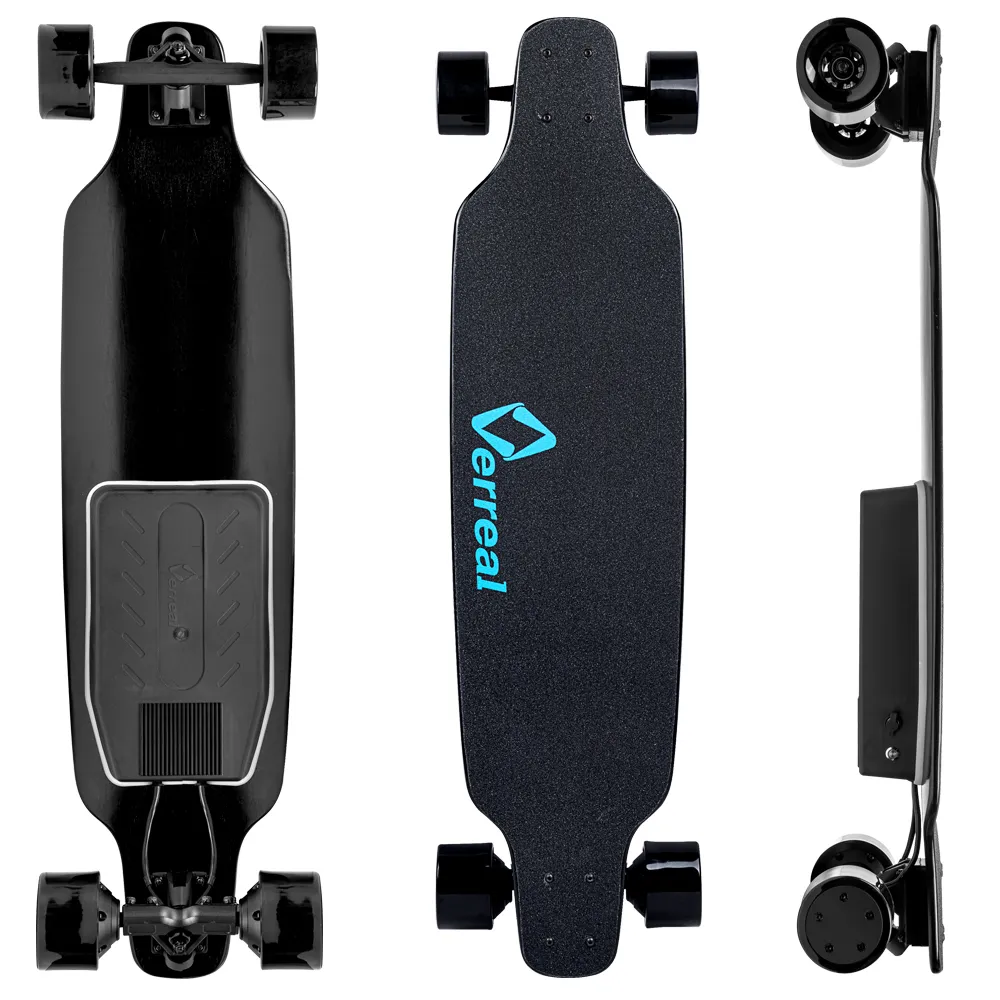
4. Verreal F1 Max — from $329
Best value, most battery options
| Spec | Detail |
|---|---|
| ESC | Hobbywing |
| Battery | Multiple options (see below) |
| Warranty | 6 months |
| Stock | US, EU (select SKUs) |
Battery options:
- $329 — 10S2P 144Wh (~14km range)
- $359 — 92.5Wh airline-friendly battery (~9km)
- $419 — 2× 92.5Wh airline-friendly batteries (~18km)
- $459 — 10S2P 360Wh (~36km range)
- $569 — 10S3P 555Wh (~56km range)
The F1 Max has been in production since 2018 — that’s 8 years of iteration on the same platform. At this point, the reliability issues that affect newer boards have long since been worked out. The motor is durable, the Hobbywing ESC is well-tuned, and the range of battery options is genuinely unique at this price point.
If you travel frequently and want a board you can take on a plane, the airline-friendly battery configuration is something almost no other beginner board offers.
I’ll be honest: the build quality and visual finish aren’t as polished as some competitors, and the price doesn’t leave as much room for dramatic discounts as it once did. But if you contact us directly, we can usually work something out.
What the F1 Max offers that’s hard to find elsewhere: proven reliability, Hobbywing ESC, and more battery flexibility than any other board in this price range.
Best for: Riders who want the longest range options, frequent travelers who need an airline-friendly battery, or anyone who wants to spend the least to find out if electric skateboarding is for them.
Quick Comparison
| Board | Price | ESC | Battery | Est. Range | Warranty |
|---|---|---|---|---|---|
| WowGo 2S MAX | $359 | Hobbywing | 216Wh | ~21km | 9 months |
| Backfire G2 | $349 | Hobbywing | 187Wh | ~18km | 6 months |
| Meepo V5 | $399 | Lingyi | 144Wh | ~14km | 6 months |
| Verreal F1 Max | from $329 | Hobbywing | 144–555Wh | 14–56km | 6 months |
Don’t Forget Safety Gear
Is electric skateboarding safe? Yes — if you treat it with respect. The board itself is not the danger. Overconfidence in the first few rides is.
Electric skateboards accelerate faster than you expect and brake harder than a regular board. Falls happen, especially early on. A helmet, wrist guards, and knee pads are non-negotiable.
Get a proper skate or cycling helmet — not a fashion helmet. Wrist guards are especially important because when you fall, the instinct is to put your hands out first.
Start in the lowest speed mode. Give yourself a few sessions before you push any limits. The gear is cheap. The hospital is not.
Final Thoughts
The best beginner electric skateboard isn’t the fastest or the most powerful — it’s the one that’s reliable, smooth, and honest about what it can do.
Look for Hobbywing ESC, a battery large enough for your actual riding needs, a motor above 90mm, and a brand that’s been around long enough to have worked out the early problems.
Any of the four boards above will give you a solid first experience with electric skateboarding. Start in the lowest speed mode, wear your gear, and give yourself a few sessions before pushing the limits.
If you have questions about any of these boards or want help choosing, join our Discord community — happy to go deeper on anything here.
Related Reading: